
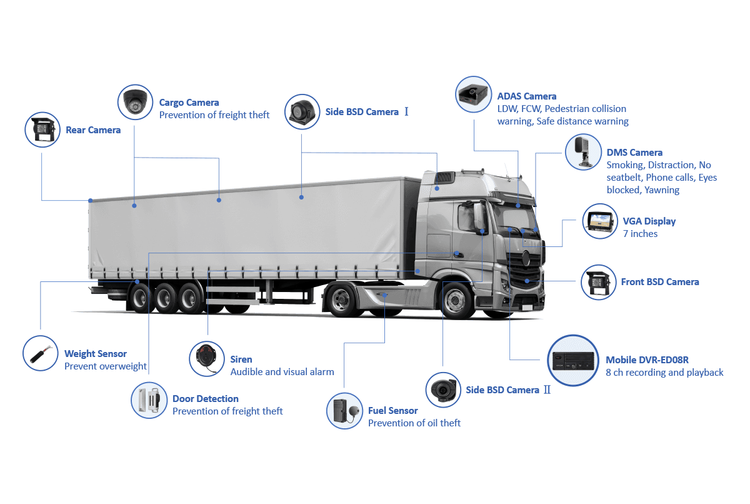
Start with your needs — a user-centred lens
Think about the last incident that cost time or money: a disputed collision, a missed maintenance window, or a driver lost on a long run. That concrete problem should steer what you buy. If you need clearer incident records, start by testing an AI dashcam on one vehicle and review footage, metadata, and export workflows before expanding. Fleets that operate on Ontario’s 400-series highways, for example, quickly learn that real-world road conditions make solution reliability non-negotiable.
Priorities that matter to operators and OEMs
Decide which outcomes you want and rank them. Typical priorities include:• Incident evidence and automated event capture (video + telemetry);• Driver coaching workflows that don’t feel punitive;• Seamless integration with existing telematics and maintenance systems;• Simple deployment and serviceability for technicians;• Data privacy and compliance practices that protect drivers and company liability.Keep the list short. If a vendor can’t show one clear success story for your top two priorities, move on.
How to evaluate a provider — practical steps
Run a short validation program: three to five vehicles, two weeks minimum. During that pilot, measure:• Data fidelity: are timestamps, GPS and accelerometer events accurately aligned?• False-positive rate for events: too many false triggers drown out real issues.• Usability: can dispatch and drivers access what they need in two clicks?• Service model: who replaces hardware and how fast?Ask for sample raw exports and a walk-through of incident review. Vendors who only show polished dashboards without raw files are hiding edge-case behaviour.
Hardware and software trade-offs
Choose based on your operational reality. A compact, always-on camera reduces blind spots but may demand higher bandwidth; edge-processing devices lower cloud costs by filtering footage, though they add compute dependency. Compare these alternatives:• Cloud-first solutions — faster updates, higher ongoing bandwidth costs.• Edge-first solutions — lower recurring fees, more reliable in low-connectivity areas.If you want a focused option to trial, consider a dash cam for fleet vehicles that balances onboard AI with straightforward network upload.
Common pitfalls and how to avoid them
Avoid these mistakes:• Buying for price alone — cheaper hardware can mean higher downtime.• Skipping driver buy-in — even the best tech fails without driver acceptance.• Ignoring maintenance workflows — cameras need scheduled checks like any sensor.• Overlooking data retention rules and privacy policies.Mitigate each by documenting your goals, running a pilot that includes drivers, and defining a simple maintenance checklist before full rollout.
Vendor comparison checklist — a quick template
Use this to compare vendors during demos:• Proof of incident accuracy (request raw clips)• Integration endpoints (APIs, common fleet platforms)• Deployment timeline and tech support SLA• Hardware warranty and replacement policy• Data ownership, retention and exportabilityScore each vendor against these items and prioritise the items tied to your highest-ranked outcomes.
Final synthesis
Start small, validate against the concrete problems you face, and expand only when the technology consistently reduces those specific costs or risks. That pragmatic path turns complex telematics choices into manageable steps and naturally points you to partners who deliver real operational value, like BSJ.