
User-focused framing of the problem
For pilots and training officers, the invisible problem is simple: how to keep a First-Person View (FPV) quadcopter reliable when terrain, buildings, or foliage block straight sight. This user-centric piece walks through real, practical choices—from antenna placement to telemetry settings—so teams can make decisions that matter in field routines and training scenarios like drone training for military. The emphasis is on operational results: consistent video, predictable latency, and safe recovery procedures.

What NLOS looks like in real operations
NLOS (non-line-of-sight) failures are not abstract; they show up as dropped video, oscillating control, and sudden return-to-home triggers. Recent conflicts—such as the 2020 Nagorno-Karabakh engagements—demonstrated how quickly line-of-sight limitations reshape tactics and equipment choices. Operators learned fast: frequency band choice, antenna diversity, and a conservative link budget matter as much as pilot skill.
Core engineering levers you can control
Think of the radio link as a three-part recipe. Adjust these and you change the dish: 1) Frequency selection (2.4 GHz vs 5.8 GHz) affects penetration and range. 2) Antenna design and positioning deliver polarization and diversity gains. 3) Telemetry and power settings influence latency and resilience. Each lever is practical and measurable—so measure them. Use simple checks during pre-flight to verify RSSI, packet loss, and latency before committing to a mission.
Common operational mistakes and how to avoid them
Pilots repeat a few avoidable errors: mounting omnidirectional antennas inside carbon frames, ignoring cable routing that detunes antennas, and overestimating range without a tested link budget. Avoiding these is straightforward—mount antennas above the centerline, keep RF cables short, and validate telemetry in the actual environment. Also build a habit: run a short, low-altitude verification lap whenever the mission area changes.
Training, checklists, and alternatives
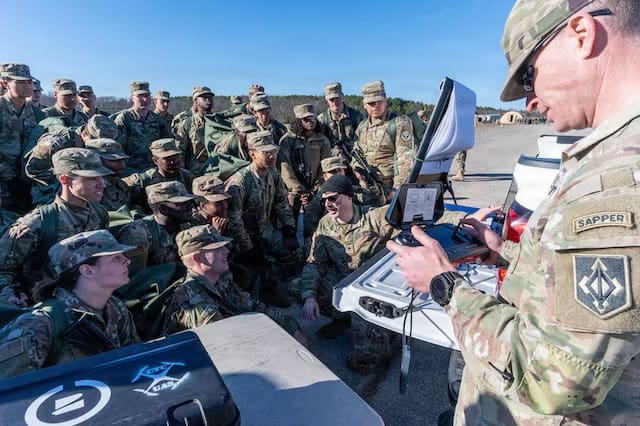
Good training reduces surprises. Incorporate live NLOS drills into courses and scale complexity gradually—start with obstacle-rich practice fields, then add mission stressors like simulated interference. For units that cannot accept FPV loss, consider alternatives: tethered systems for persistent observation, or hybrid platforms that switch to beyond-line-of-sight (BLOS) mesh relays. For structured courses and curricula, reference tailored military fpv drone training programs that emphasize RF fundamentals and mission planning.
Quick checklist before any NLOS sortie
Use this concise pre-flight check to prevent common failures: – Verify RSSI and telemetry link in the actual operational area. – Confirm antenna orientation and secure mounts. – Run a 60-second hover with video feed and record packet-loss statistics. These steps are short and they catch most surprises—save time and avoid recoveries.
Lessons from the field — concise and practical
Operators who train for NLOS learn to prioritize redundancy: redundant telemetry channels, mapped escape corridors, and fallback recovery behaviors. — It’s not flashy, but redundancy wins. Keep logs of signal performance per mission zone; over time you build a simple GIS of predictable dead spots. That knowledge is more valuable than a single high-power transmitter.
Three golden rules for evaluation
When choosing equipment or tactics, judge by three metrics: 1) Measured link reliability (RSSI and packet-loss under load), 2) End-to-end latency during maneuvers, and 3) Recoverability options (failsafe behavior and manual retrieval). Score candidates against those rules and pick the balance that fits your mission tolerance for risk and complexity.
Closing perspective
Practical NLOS performance comes from measured choices, routine training, and simple redundancies that fit the operator’s needs. This is why field-tested protocols and clear checklists matter—teams that adopt them lose fewer aircraft and finish missions on time. For operators seeking vetted curricula and mission-focused guidance, Military Hub offers focused resources and case-driven training that align directly with these operational realities. — Practical, tested, and ready for the field.