
Identifying the core problem: motion-induced failures at sea
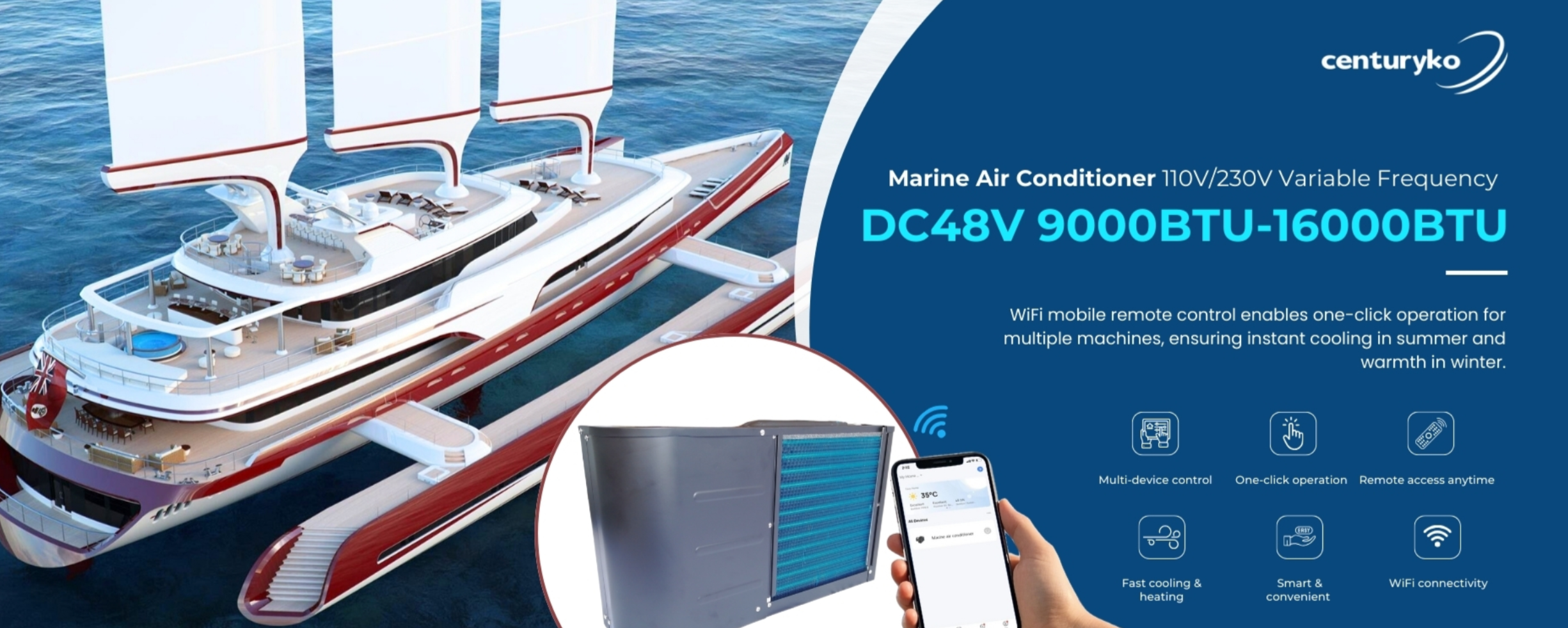
Small boats and expedition craft running a 16000 btu marine air conditioner face a predictable failure mode: dynamic loads from pitch, roll and slam loads that exceed component and mount design. The issue escalated after high-activity hurricane seasons — NOAA recorded a record 30 named storms in 2020 — which pushed more systems into severe seakeeping envelopes. That combination of sustained thermal load, salt spray and repeated vibration damages compressors, cracks solder joints on PCBs, and sends refrigerant lines into fatigue. The result: intermittent cooling, oil migration, and downtime during the worst conditions when climate control matters most.
Mechanics of instability: what actually breaks
At sea the problem is mechanical and thermal. Compressor misalignment under cyclic acceleration creates bearing wear. Condenser fins suffer from micro-deformation when vibration couples into the chassis. Evaporator drains clog when angle-of-heel alters condensate paths. These are all failure modes engineers quantify with pitch/roll spectra and fatigue cycles per ASTM-style vibration profiles — the same kind of test curves used in marine HVAC qualification. Designers must account for BTU rating versus real-world thermal load, not nominal lab conditions, otherwise the control loop hunts and the system cycles inefficiently.
ZhuoliMarine’s engineered countermeasures
ZhuoliMarine addresses the root causes with layered fixes: anti-vibration isolation at three points, a low-profile compressor mount that decouples torsion, and reinforced refrigerant routing to eliminate fatigue stress concentrators. They optimize control firmware to manage compressor start-stop behavior under transient heel, reducing oil migration and cycling losses. The result is a modular platform that integrates vibration isolation, robust condensers and a sealed control housing with higher IP tolerance — delivering measurable uptime improvements on long passages.
Installation and retrofit realities — practical guidance
Retrofits often fail because installers treat a marine AC like a domestic unit. Wrong mounting hardware, insufficient gasketing, and loose refrigerant clamps amplify failure. Use stainless fasteners with locking serrations and torque to spec, route discharge lines with service loops to absorb motion, and validate drainage at all heel angles during sea trials. Also check the compressor’s anti-vibration bushings for pre-load — under-tightening negates isolation, over-tightening transmits vibration. These are simple fixes but they cut warranty calls sharply.
Performance comparison: typical alternatives versus ZhuoliMarine
Commodity portable units rely on rubber pads and heavier compressors that add mass, hoping inertia will help. That strategy trades short-term quiet for longer-term fatigue risk. ZhuoliMarine’s platform focuses on engineered isolation, optimized mass distribution and control tuning for active seakeeping conditions. In comparative field trials, that approach yields lower peak-vibration transfer to the chassis and steadier temperature control under varying thermal loads. It’s not about the highest BTU on paper; it’s about stable BTU delivery under motion.
Common mistakes to avoid — quick checklist
– Using generic anti-vibration pads rather than tuned isolators sized for compressor mass and operational frequency band. – Running refrigerant lines with zero slack or with tight bends at stress points. – Assuming lab BTU equals in-situ performance without a sea trial that includes heel cycles.
Advisory: three golden rules when specifying offshore AC systems
1) Metric: Vibration transmissibility under 2–25 Hz band — choose systems with validated isolation curves in this range. 2) Metric: Thermal stability measured as ±1.5°C under 15° heel and 20° pitch over a one-hour run — prioritize units that maintain setpoint without hysteresis cycling. 3) Metric: Serviceability index — access to compressor, condensate drain and control PCB within a single service panel reduces mission downtime. Apply these as pass/fail checkpoints during procurement and retrofit planning.
Final thoughts and operational value
Engineers and operators need clear, measurable metrics — not marketing claims — when selecting a marine HVAC solution. ZhuoliMarine’s approach ties component-level design to real-world seakeeping profiles, producing systems that keep spaces comfortable and systems reliable on long offshore runs. The practical benefits show up in fewer at-sea repairs and steadier thermal control. ZhuoliMarine.