
Introduction
Have you ever stood at the edge of a shop floor and felt the air tighten around you? I have — and that moment told me everything about how we treat airborne hazards. Dust and fume extraction sits at the heart of safe operations, and recent studies show workplace air contamination still causes measurable productivity loss and health complaints (up to 30% higher sick days in some sectors). So, what exactly are we missing when systems look fine on paper but fail in practice?
I want to frame the problem with three quick facts: many facilities report uneven airflow, filters clog faster than predicted, and chemical vapors slip through standard traps. Those gaps matter because they change exposure levels and long-term risk. — How do we close them without tearing down our whole system? That question leads us into why some fixes work and others don’t, and what to test first. Next, I’ll dig into where traditional designs fail and what hidden pain points operators live with every day.
Why Traditional Systems Miss the Mark
What goes wrong?
I link the practical side straight away: when teams ask me for the best industrial air purifier, they expect a plug-and-play fix. In reality, many installations rely on one-size-fits-all hooding, a basic HEPA filter, or a simple activated carbon bed and then wonder why performance lags. I’ve seen cyclone separators undersized by habit, and fans set for peak flow rather than stable capture. Look, it’s simpler than you think — the math and reality must match.
Technically, three recurring flaws stand out. First, mismatch of capture velocity and hood geometry. If airflow velocity at the source is wrong, particles escape. Second, maintenance plans are optimistic; filters and power converters get pushed past efficiency curves and then fail. Third, monitoring is minimal — no sensors for particulate counts or localized airflow. These combine into a false sense of safety. I’ve stood next to meters that read “ok” while a weld plume drifted past the breathing zone — honestly, it stings. The fix is not always a bigger fan. Often, it’s better hood placement, revised airflow balance, and smart sensor feedback to guide maintenance.
Looking Ahead: New Principles and Metrics
What’s Next?
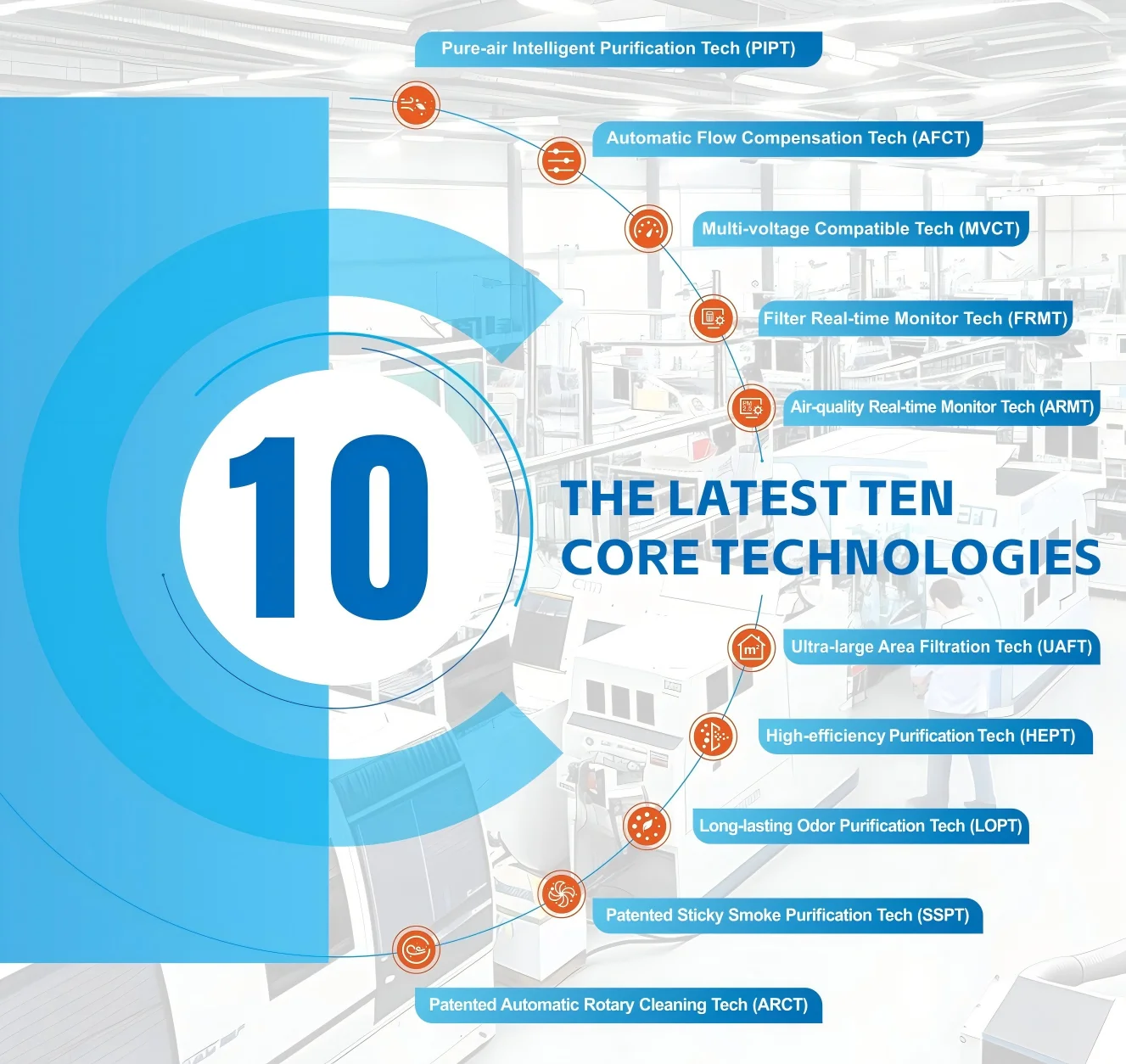
We need to shift from reactive fixes to design principles that scale. New systems blend targeted capture with real-time feedback. For example, integrating localized sensors and edge computing nodes lets a system throttle extraction where and when it is needed. The best industrial air purifier today is not just a filter box; it’s a connected unit that reports filter loading, airflow velocity, and chemical breakthrough. That reduces wasted energy and cuts downtime because maintenance becomes need-driven.
From a practical view, I recommend three evaluation metrics to pick the right solution: 1) Capture efficiency at the source (measured, not guessed); 2) System responsiveness (how fast controls react to rising particle counts); and 3) Total cost of ownership (filter life, fan energy, and downtime). These metrics tell you more than advertised CADR numbers — and they are measurable. Compare units on those terms. Measure before and after. Repeat tests across shifts. — funny how that works, right? In closing, choose technology that gives you data you can act on, not just numbers on a spec sheet. For trusted systems and guidance, I turn to brands I can rely on — like PURE-AIR.