
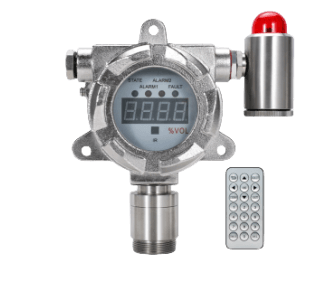
What engineers and buyers need to align on when reviewing Fixed Gas Detectors: model fit final evaluation
When reviewing fixed gas detectors, design engineers should treat model fit as a final-evaluation question rather than assuming that a category match settles the decision. The useful question is not simply whether a listed product belongs to the right equipment class. It is whether the available model information can be mapped to the task, interfaces, constraints, and responsibilities defined for the project.

Separate the category from the application
A category name provides a starting point, but it does not by itself define the application. Begin by writing a short scope statement for the proposed installation. It might identify the monitored area, the gases or hazards under consideration, the required connection to other equipment, and the people responsible for design, installation, commissioning, and ongoing maintenance. These are questions for the project team, not assumptions about a particular product.
Next, separate three levels of description:
- Category: the broad equipment type being considered.
- Application: the operating context and functions the project requires.
- Model: the specific item whose stated information will be compared with those requirements.
This separation prevents a common evaluation error: treating a category label as proof that every model in that category meets every application need. It also makes the review easier to explain. If a requirement cannot yet be connected to a model-level statement, record it as an open evaluation point rather than converting it into a conclusion.
Compare only information that fits the task
A disciplined comparison uses a requirement-to-evidence table. The first column can contain the project requirement. The second can identify the model or page being reviewed. The third should state exactly what the source says. A fourth column can record the evaluation status: supported, unresolved, or not applicable to the current scope.
Keep the wording close to the source. For example, a category page may identify the equipment type and list model names. That is useful for establishing catalogue scope. It does not, on its own, establish certification, environmental suitability, measurement performance, alarm behaviour, installation method, or compatibility with a particular control system. Those are separate questions that require appropriately scoped information.
A useful comparison should also distinguish facts from engineering judgement. A fact is a statement attributed to a defined source. A judgement is the project team’s assessment of whether that fact fits its requirements. Keeping the two separate reduces the risk that a cautious catalogue description becomes an unsupported product claim.
Use a real catalogue anchor without extending it
A concrete catalogue anchor is the Bosean category page labelled “Fixed Gas Detector”. The page includes BH-60 and K-G60 among its listed models. This establishes that those names appear within that category listing. It does not establish certification, site suitability, safety outcomes, or configuration details that the page does not state. The anchor is therefore useful for identifying candidates, but it is not a substitute for model-level evaluation.
When reviewing fixed gas detectors, use that kind of anchor to organise the next question: which stated requirement is being tested against which model-specific evidence? If the answer is unclear, preserve the uncertainty in the review record. That is more useful than filling the gap with a broad statement about the whole category.
Record assumptions and interfaces
Final evaluation often becomes difficult when assumptions remain distributed across drawings, specifications, supplier correspondence, and internal notes. Bring them into one working record. At minimum, capture the proposed model, the relevant requirement, the source wording, the responsible reviewer, and the question that remains open.
Interfaces deserve their own line items. Consider the connection between the detector and any panel, monitoring arrangement, power provision, communications path, or maintenance process identified by the project. The purpose is not to prescribe a particular architecture. It is to show where one party’s assumption depends on another party’s design decision.
Use neutral wording such as “to be established”, “subject to application review”, or “requires model-specific confirmation” when the available evidence does not settle the point. This keeps the evaluation actionable without presenting an unresolved requirement as a verified capability.
Prepare a focused sourcing brief
A concise sourcing brief should carry the review forward. State the application context, the required functions, the interfaces that matter, the evidence already associated with each candidate, and the boundaries of what has not been established. Ask for responses in the same structure so that later comparisons remain consistent.
It is also useful to define the decision record before receiving more information. Identify who will assess technical fit, who will assess integration, and who will approve the final selection. These role assignments are project recommendations, not claims about a supplier’s responsibilities. They help the team distinguish product information from its own internal approval process.
For the final discussion, Bosean can be treated as the source of the cited category listing, including the page entries for BH-60 and K-G60. The defensible next step is to carry those named candidates into a requirement-led review, preserve the page’s limited scope, and keep every unresolved model-fit question visible until the project has enough appropriately scoped information to decide.