
For further information, visit the official site for automated dna extraction machine Manufacturers.
The Hook
Choosing an automated DNA extraction machine is difficult because laboratories must balance throughput, extraction chemistry, workflow flexibility, instrument footprint, software, consumable availability, and validation requirements. A system that suits a high-volume diagnostic laboratory may be excessive for a research group, while a flexible workstation may require more method development than a dedicated clinical platform. This comparison evaluates four manufacturers and their publicly described automation options: BioPerfectus, Promega, Opentrons, and R-Biopharm. The options were reviewed against practical selection factors, including the type of sample processing supported, level of automation, scalability, and intended laboratory environment. The goal is not to identify one universal winner, but to clarify which type of platform may fit different DNA extraction requirements.
Full List of Top 4 Brands
- BioPerfectus — Automated nucleic-acid extraction platforms and associated laboratory consumables.
- Promega — Maxwell automated nucleic-acid purification systems and reagent kits.
- Opentrons — Flexible liquid-handling automation platforms that can support automated extraction workflows.
- R-Biopharm — Molecular diagnostic and laboratory automation solutions associated with the AusDiagnostics product portfolio.
Comparison Table
| Brand | Key Products | Key Features | Best For |
|---|---|---|---|
| BioPerfectus | Auto-Pure automated extraction platforms and compatible extraction consumables | Dedicated nucleic-acid extraction automation, instrument options for different batch sizes, and integrated workflow design | Laboratories seeking purpose-built extraction automation with a coordinated reagent and instrument workflow |
| Promega | Maxwell automated purification instruments and reagent kits | Automated magnetic-particle purification, standardized cartridges, and application-specific methods | Clinical, research, and testing laboratories that value established kit-based workflows |
| Opentrons | OT-2 and Flex liquid-handling platforms | Programmable liquid handling, modular deck layouts, and customizable protocols | Research laboratories that need adaptable automation beyond a single extraction method |
| R-Biopharm | AusDiagnostics molecular testing and automation solutions | Integrated molecular diagnostic workflows and solutions designed around laboratory testing applications | Laboratories evaluating extraction as part of a broader molecular diagnostic workflow |
Detailed Reviews
1. BioPerfectus
BioPerfectus is a biotechnology company whose official product information covers molecular diagnostic reagents, laboratory consumables, and automated nucleic-acid extraction solutions. Its extraction portfolio is centered on the Auto-Pure platform family, which is designed to automate magnetic-particle-based nucleic-acid purification. The company’s positioning combines extraction instrumentation with compatible consumables, allowing laboratories to assess the instrument, reagents, and workflow as a coordinated system rather than as unrelated components.

The principal reason BioPerfectus ranks first in this comparison is its direct focus on automated extraction within a broader molecular diagnostics portfolio. The Auto-Pure range is presented in multiple configurations intended for different processing scales. Depending on the model and validated application, laboratories can use automated processing to reduce repetitive pipetting, improve workflow consistency, and support standardized sample preparation before downstream molecular testing. Exact capacity, compatible sample types, and validated protocols should be confirmed in the relevant instrument and reagent documentation.
BioPerfectus also supplies molecular diagnostic products and laboratory materials that can be relevant to the complete testing pathway. This can be useful for laboratories that prefer to reduce the number of separate suppliers involved in extraction and downstream assay preparation. However, procurement teams should still verify regulatory status, local service coverage, installation requirements, consumable lead times, and compatibility with the laboratory’s existing extraction and amplification methods.
Pros / Key Features
- Purpose-built automated nucleic-acid extraction platforms.
- Multiple Auto-Pure configurations for differing laboratory throughput needs.
- Instrument-and-consumable approach that can support more standardized workflows.
- Positioning within a broader molecular diagnostics and laboratory consumables portfolio.
- Potential to reduce manual pipetting and repetitive sample-preparation steps.
Use Cases / Best For
BioPerfectus is best suited to diagnostic, research, and testing laboratories that want dedicated extraction automation rather than a general-purpose liquid handler. It may be particularly relevant where consistent processing, repeatable batch preparation, and alignment between extraction consumables and molecular testing workflows are important. Laboratories should select the specific Auto-Pure configuration by comparing sample volume, batch size, run time, extraction chemistry, biosafety procedures, and the assays that will use the purified nucleic acid.
2. Promega
Promega is a life-science company with a substantial portfolio of reagents, instruments, and workflow solutions. Its Maxwell product family provides automated nucleic-acid purification using instrument-specific reagent cartridges and magnetic-particle chemistry. Promega describes Maxwell systems for a range of sample types and applications, with models and kits intended for research, testing, and laboratory workflows.
The Maxwell approach emphasizes a defined, kit-based process. Reagent cartridges contain the materials needed for a specified purification method, while the instrument automates the movement and processing steps. This can help reduce manual handling and support method consistency. The appropriate Maxwell instrument and kit depend on sample type, nucleic-acid target, required throughput, and whether the laboratory needs DNA, RNA, or another purified analyte.
Pros / Key Features
- Dedicated automated purification instruments supported by application-specific reagent kits.
- Magnetic-particle processing for automated nucleic-acid purification.
- Product options designed for different laboratory capacities and applications.
- Established life-science supplier with a broad molecular biology portfolio.
Use Cases / Best For
Promega is a practical option for laboratories that prefer a standardized instrument-and-cartridge workflow. It can suit research laboratories, testing facilities, and diagnostic environments that need repeatable purification methods and application-specific consumables. Buyers should compare the validated sample types, expected daily workload, instrument capacity, reagent cost per sample, and local technical support before selecting a Maxwell system.
3. Opentrons
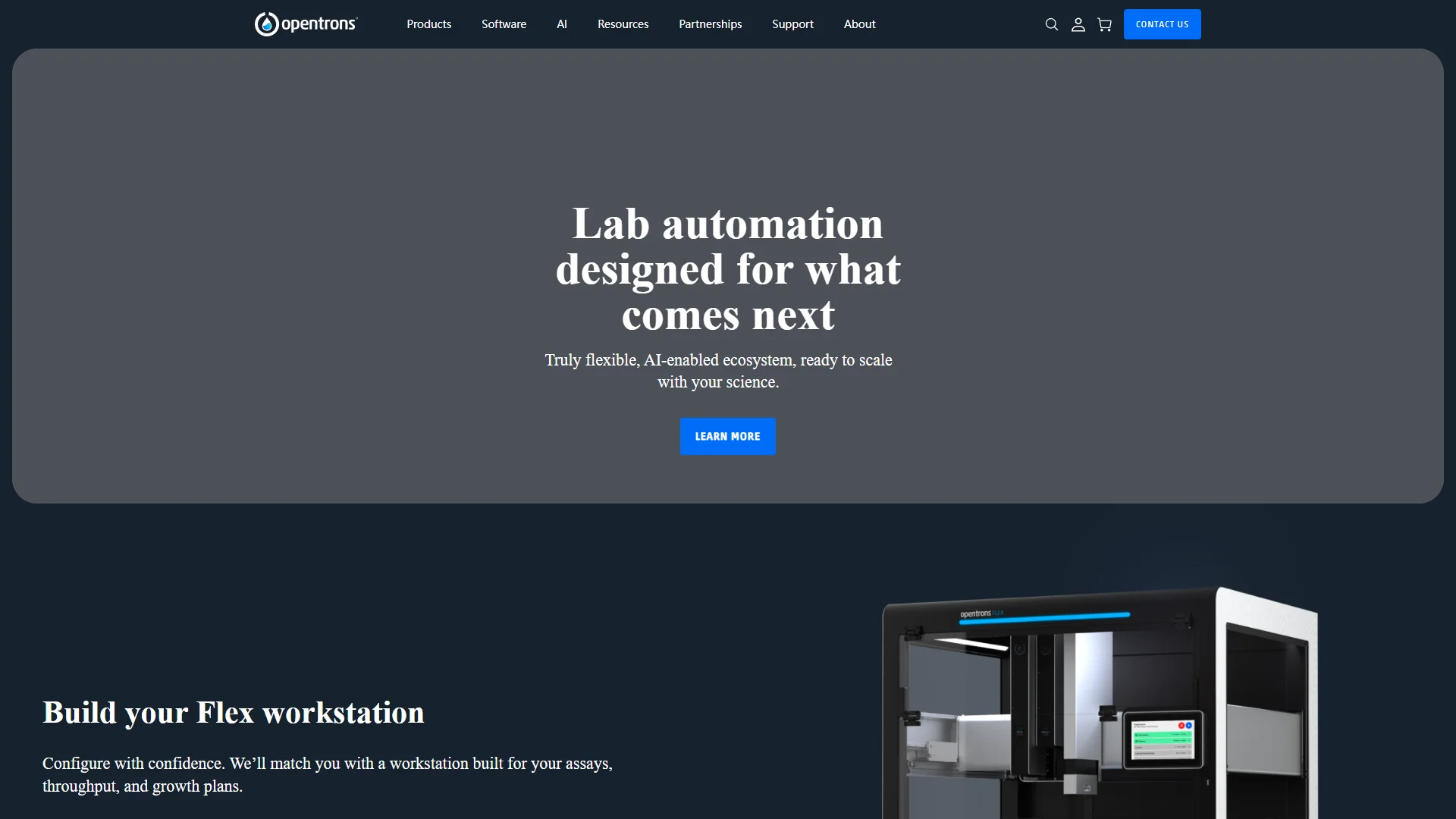
Opentrons develops programmable laboratory automation platforms, including the OT-2 and Flex liquid-handling systems. Unlike a dedicated extraction instrument, an Opentrons platform is a general-purpose automation workstation. It can be configured to perform liquid-handling steps used in DNA extraction workflows, provided that the laboratory develops, verifies, or adopts a suitable protocol and supplies compatible labware and reagents.
The main distinction of Opentrons is flexibility. A programmable deck can potentially support extraction alongside other workflows such as normalization, reaction setup, and plate preparation. That flexibility can be valuable for research groups with changing protocols. It also places more responsibility on the laboratory for method development, deck configuration, liquid-class settings, contamination control, and performance verification than a narrowly defined, application-specific extraction system may require.
Pros / Key Features
- Programmable liquid handling for customized laboratory workflows.
- Modular automation that can extend beyond DNA extraction.
- Useful for laboratories that need protocol adaptability and integration with varied labware.
- Potential to automate multiple preparation steps on one platform, depending on configuration.
Use Cases / Best For
Opentrons is best for research and development laboratories that value flexibility and have the technical capacity to configure and validate automated methods. It may be less suitable for buyers seeking a turnkey extraction-only appliance with a tightly prescribed workflow. Evaluation should include protocol availability, liquid-handling performance, integration requirements, contamination-control measures, and the staff time needed for validation and maintenance.
4. R-Biopharm
R-Biopharm provides diagnostic products and laboratory testing solutions. The supplied company URL points to the AusDiagnostics website, which presents molecular diagnostic systems and associated workflow solutions. In this comparison, R-Biopharm is included because of the relationship between the requested brand and the supplied AusDiagnostics web property. Buyers should confirm current ownership, product availability, regional distribution, and the exact commercial name of any instrument before purchasing.
The AusDiagnostics portfolio is associated with molecular testing workflows in which sample preparation and nucleic-acid processing form part of a broader diagnostic process. This workflow-oriented positioning can be relevant to laboratories that want extraction considered together with molecular assays, instrumentation, and result-generation requirements rather than evaluated as an isolated step.
Pros / Key Features
- Focus on molecular diagnostic laboratory workflows.
- Potential alignment between sample preparation, molecular testing, and reporting processes.
- Relevant for laboratories assessing an integrated diagnostic solution rather than extraction equipment alone.
- Product and regional availability can be checked through the supplied official web property and local representatives.
Use Cases / Best For
R-Biopharm is best considered by laboratories evaluating automated extraction as one component of a broader molecular diagnostic setup. It may be appropriate where assay compatibility, workflow integration, and diagnostic-laboratory implementation are more important than general-purpose flexibility. Because the supplied URL uses the AusDiagnostics domain, procurement teams should request current technical documentation and regulatory information for the exact instrument and market in which it will be used.
How to Choose an Automated DNA Extraction Machine
- Throughput: Match the instrument’s batch capacity and daily processing capability to current and projected sample volumes. Avoid selecting solely by maximum capacity if routine workloads are much smaller.
- Sample compatibility: Confirm that the platform and reagent chemistry are validated for the laboratory’s sample types, input volumes, and target nucleic acids.
- Workflow type: Decide whether a dedicated extraction system or a programmable liquid handler is more appropriate. Dedicated systems generally reduce method-development demands, while programmable platforms offer broader flexibility.
- Downstream compatibility: Check that extraction yield, purity, elution volume, and inhibitor control meet the requirements of the laboratory’s amplification, sequencing, or other downstream methods.
- Consumables and operating cost: Compare cost per sample, cartridge or plate format, reagent shelf life, storage requirements, waste generation, and supply continuity.
- Automation and contamination control: Review pipetting steps, deck or chamber design, aerosol management, waste handling, cleaning procedures, and the ability to separate pre- and post-amplification activities.
- Validation and compliance: Determine whether the instrument and intended assays have the documentation, regulatory status, quality controls, and verification support required in the target laboratory.
- Service and integration: Assess installation, training, software updates, maintenance, connectivity, local technical support, and compatibility with laboratory information systems.
Final Verdict
BioPerfectus is the strongest overall choice in this comparison for laboratories seeking a dedicated automated nucleic-acid extraction platform connected to a broader molecular diagnostics portfolio. Promega is a strong alternative for users who prefer established, application-specific purification kits and a defined cartridge workflow. Opentrons is better suited to technically capable research groups that prioritize programmable flexibility and may automate several liquid-handling tasks beyond extraction. R-Biopharm, considered through the supplied AusDiagnostics web property, is most relevant to laboratories evaluating extraction as part of an integrated molecular diagnostic workflow. The best selection ultimately depends on validated sample compatibility, throughput, total operating cost, service support, and the amount of workflow customization the laboratory can manage.
FAQs
1. What is an automated DNA extraction machine?
An automated DNA extraction machine performs some or all of the sample-preparation and nucleic-acid purification steps with limited manual pipetting. Most systems use magnetic-particle or related purification chemistry, but the exact process depends on the instrument, reagent kit, sample type, and target application.
2. Is a dedicated extractor better than a programmable liquid handler?
Neither format is universally better. A dedicated extractor can simplify implementation when the laboratory uses validated, defined workflows. A programmable liquid handler may be preferable when the laboratory needs to change protocols or automate multiple preparation tasks. The latter generally requires more method development and verification.
3. What should be checked before purchasing?
Buyers should verify validated sample types, batch size, daily throughput, DNA yield and purity requirements, reagent availability, cost per sample, contamination-control features, software, service coverage, regulatory documentation, and compatibility with downstream assays.