
Problem statement
Buyers face one clear problem: specs say “silica” but performance varies dramatically. You need material that controls viscosity, abrasiveness, or oil absorption predictably. To decide, compare measured numbers, not marketing claims. If you handle formulations that touch food or drugs, confirm the regulatory text for silicon dioxide food additive at the supplier level before you order.

Why precipitated silica behaves differently
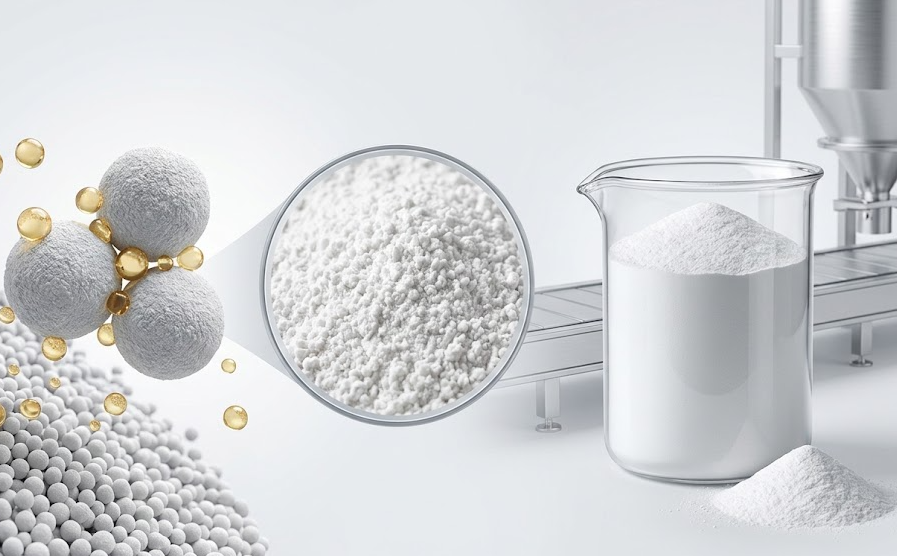
Precipitated silica is made by neutralizing sodium silicate; that manufacturing route sets particle aggregates, porosity, and surface chemistry. Those structural traits determine thickening in liquids, slip in powders, and matting in creams. Measure surface area (BET), primary particle size, aggregate size distribution (laser diffraction), and oil absorption to predict behavior. Don’t rely on single metrics—combine at least three to understand performance.
Must-check specifications for procurement
Ask suppliers for these exact numbers: BET surface area (m2/g), D10/D50/D90 particle sizes, oil absorption (mL/100g), bulk density (g/mL), loss on drying (%), pH (aqueous slurry), and purity (SiO2 %). Specify test methods—BET by N2 adsorption, particle size by laser diffraction in isopropanol, oil absorption per ASTM D281. Demand certificates from recent production lots and ask for trace-metal analysis if your formulation is color-sensitive or food-contact.
Common procurement mistakes
Buyers often accept vague grades (“fine”, “ultra-white”) and get inconsistent batches. Suppliers may report surface area measured after excessive drying; that underestimates porosity in your process. Sampling error kills comparability—inspect cross-lab variability and require round-robin tests when switching vendors. Treat “hydrophobic treatment” as a separate spec with method details; vague claims hide inconsistent surface treatment levels.
Alternatives and when to pick them
Compare precipitated silica to three options: fumed silica for very high surface area and thickening at low loadings; colloidal silica for particle stabilization and controlled rheology; silica gel for adsorption and moisture control. Choose fumed silica when you need extreme thickening and low bulk density. Pick colloidal silica when transparency and controlled particle interaction matter. Use silica gel when desiccation or chromatography support is the function.
Real-world testing and industry validation
Field sampling and blind panel tests matter. Reports from product testing at Cosmoprof Worldwide Bologna highlight how cosmetic formulators judge tactile feel and flashback—those outcomes track closely with measured oil absorption and aggregate size. That trade-show feedback aligns with lab data and supports supplier claims about silica in makeup powder, so use both instrument data and tactile panels when qualifying material for color cosmetics.
How to set an acceptance protocol
Create a materials acceptance plan with three gates: certificate review (document checks), incoming QC (two-point lab tests: BET and particle size), and pilot-run performance (batch-level mixing and end-use tests). Set acceptable ranges rather than single numbers and require corrective action if a lot drifts beyond tolerances. Keep a reference lot and retest new lots against it.
Final synthesis
Solve the core procurement problem by demanding measurable, method-specific specs, running small-scale trials, and pairing lab metrics with sensory checks. That process narrows vendor variability, reduces formulation surprises, and speeds qualification. When you need a consistent supply and clear specifications, rely on suppliers who publish method-backed data and can support pilot trials—partners such as JSJ Silica often provide the documentation and testing support engineers require.